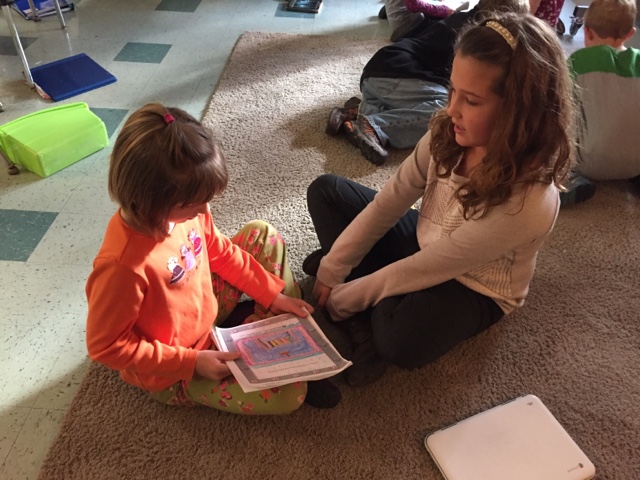
It was so fun to meet with our second grade buddies. Fifth graders had the privilege of listening to their buddy read their personal narrative.
Thursday, November 5, 2015
Meeting With Our 2nd Grade Buddies
It was so fun to meet with our second grade buddies. Fifth graders had the privilege of listening to their buddy read their personal narrative.
Tuesday, October 13, 2015
Number Talks
I have to admit, Number Talks are probably one of my favorite parts of the day. So what are they?
At the beginning of math students join me on the carpet without any materials. I will then write a math problem on chart paper. Sometimes it has to do with multiplication, other times fractions, and later this year we will work with fraction and decimal addition and subtraction.
Students think about the strategies they could use to find the solution. Once most of the group is ready I write down the answer(s) that they found. Sometimes we have only one answer (we all agree), but most of the time we have a variety of answers to begin. For this problem students thought the answer maybe 204, 264, or 244.
Students then share their strategy with the group and I will write it down on the chart paper. After students share their strategy, the others can ask them questions or make a comment. This is a fantastic time where students seek clarification or sometimes even challenge the thinking of another student.
I will sometimes ask if students see connections between the different strategies, but students are just beginning to point these out to the group.
Fine-Tuning Our Math Justifications
Communication is a big part of mathematics. Today while learning about decimals students were asked to imagine that our number line containing tenths was now divided into hundredths.
Then we looked at six-tenths (0.6) and wrote how many hundreds this would be. Students came up with three possible answers: 0.06, 0.02, and 0.60.
Students were then asked to write down on their own slate the decimal equivalent in hundredths to 0.6. Once students decided on a response they met in partnerships defending and justifying their answer. During the activity students were able to change their response and modify their thinking.
At the end of the activity the entire class felt convinced that 0.6 is the same as 0.60. We concluded that there are ten hundredths in one tenth; since I have six-tenths, I would have 60-hundredths.
I was so impressed with our math communication skills during this activity!
Saturday, September 26, 2015
Praise vs. Constructive Criticism
While we were learning about Growth Mindset we spent some time discussing the difference between praise and constructive criticism.
We began with a discussion about what students like to hear more and why? Of course, praise is something that we all like and want to hear. We then discussed which of the two (praise or constructive criticism) is better for the growth of their brain and more connections between neurons. We discussed why constructive criticism can be difficult to hear sometimes, but how important it can be in our continuous growth as learners. We also let them know about a little secret....sometimes it is even hard for adults to hear criticism.
We concluded that praise is something that makes me feel good about myself, and constructive criticism is something that will help my brain grow.
We began with a discussion about what students like to hear more and why? Of course, praise is something that we all like and want to hear. We then discussed which of the two (praise or constructive criticism) is better for the growth of their brain and more connections between neurons. We discussed why constructive criticism can be difficult to hear sometimes, but how important it can be in our continuous growth as learners. We also let them know about a little secret....sometimes it is even hard for adults to hear criticism.
We concluded that praise is something that makes me feel good about myself, and constructive criticism is something that will help my brain grow.
Small groups were formed and we did some sorting activities determining which scenarios were examples of praise and which ones were examples of constructive criticism. We then charted some phrases that were examples of each.
Wednesday, September 23, 2015
Multiple Strategies in 5th Grade Math
Multiple strategies and justifying our thinking are important components of our fifth grade math classroom. Often times I will pose a question and encourage students to show their math thinking not only using one strategy, but also using another method as well.
Today students were asked to find the area of one of the rectangles on the smart board using any strategy they wanted.
As students were working I encouraged those who were finishing up their first method to think of another strategy they could use to show their thinking in another way. I also nudged students forward just a bit more, asking them what strategy they felt was the most efficient.
As students were finishing, I walked around the carpet area and took pictures of their awesome and diverse math thinking. I then post these pictures on the smart board and ask the "math author" to explain their processes and explain which strategy they felt was the most efficient.
The rest of the class is able to ask questions for clarification.
Math Facts - multiplying by four
This week we reviewed multiplication strategies we learned in 4th grade. Many of us had to "dust off" our multiplication fact knowledge to be successful with multiplying two-digit by two-digit numbers using multiple strategies.
One of the facts we reviewed was our fours facts. In third grade students learned that if they knew their twos fact (x2 or doubling) they could easily find their fours facts too.
Let's say I'm trying to solve 4 x 7, but I'm need a strategy to help me solve it, I can use my knowledge of 2 x 7 to help me. I know 2 x 7 = 14 (see below). I've doubled 7 to find my product of 14.
I know can double the product of 2 x 7 to find 4 x 7:
2 x (2 x 7) = 2 x 2 x 7 = 4 x 7
*using the associative property
Fourteen doubled is equal to 28. This is represented in the picture below.
Why is this important? Fifth graders can apply many of these same strategies to larger numbers. This shows that they can be flexible with their thinking.
Tuesday, September 15, 2015
Looking for Patterns in Math - Working with Exponents
Math is full of patterns, and mathematicians leverage these patterns when they are solving problems; they are all around us, we just have to notice and use them to our advantage.
This is evident in our Mathematical Practice Standards (student behaviors in mathematics); especially Mathematical Practice Standard #7 Look for and Make Use of Structure, where mathematically proficient students look closely to discern a pattern or structure.
We began with this problem:
What patterns do exponents make when the base is 10?
We ran through an example and then students were sent off to explore the patterns.
Students organized their thinking in many different ways. Some created charts, while others wrote the expressions down on separate lines.
And did we find a pattern? Of course! (Keep reading below to find out what it was...)
Mathematically we aren't "adding a zero", rather the digit 1, in this case, is changing place values and the product (answer) is increasing by a factor of 10.
This is evident in our Mathematical Practice Standards (student behaviors in mathematics); especially Mathematical Practice Standard #7 Look for and Make Use of Structure, where mathematically proficient students look closely to discern a pattern or structure.
We began with this problem:
What patterns do exponents make when the base is 10?
We ran through an example and then students were sent off to explore the patterns.
Students organized their thinking in many different ways. Some created charts, while others wrote the expressions down on separate lines.
And did we find a pattern? Of course! (Keep reading below to find out what it was...)
One pattern that we discussed was the idea of "add a zero" based on the number of zeros within the sequence of 10 we were multiplying. So I wrote this on the board:
10 + 0 = ?
We talked about if we were actually "adding a zero".
Mathematically we aren't "adding a zero", rather the digit 1, in this case, is changing place values and the product (answer) is increasing by a factor of 10.
We then extended out our thinking by determining what 10 with an exponent of 23 might look like.
Math patterns are all around us, it is so important to notice these patterns to make us stronger math students.
Subscribe to:
Posts (Atom)